
Benchmarking Quality: How Precision Robotics Standards Parallel Swiss Watch Engineering
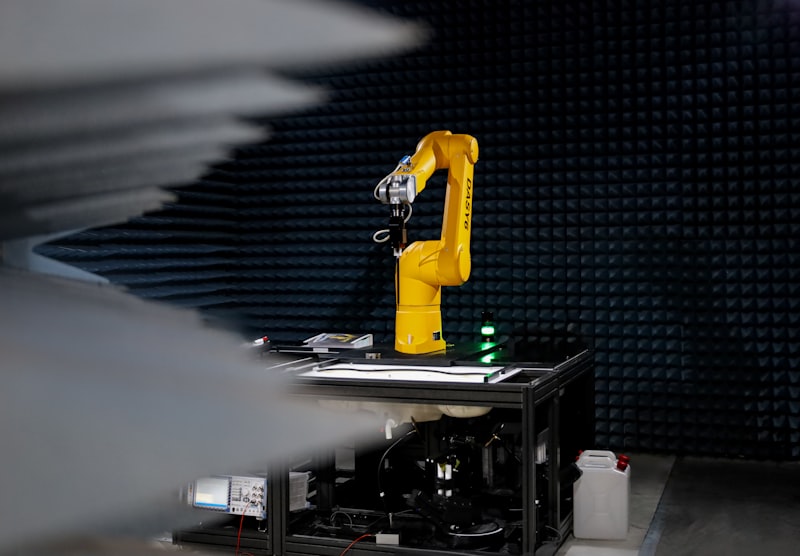
Benchmarking in robotics research exists because claims without reproducible testing are not science — they are marketing. When a laboratory publishes performance data for a manipulation system without sharing the test objects, the test protocol, and the environmental conditions, other researchers cannot verify, reproduce, or build upon the result. The benchmark provides the common ground that makes progress measurable rather than asserted.
Swiss watchmaking has its own benchmarking tradition, formalized through COSC — the Contrôle Officiel Suisse des Chronomètres — which certifies mechanical movements that meet specific rate accuracy standards across multiple positions and temperature conditions. A movement achieving COSC certification has been tested over sixteen days, in five positions, at three temperatures, and must maintain a daily rate variance of no more than minus four to plus six seconds. This is not manufacturer's claim. This is third-party verified performance data.
What the Standards Actually Measure
In robotic manipulation, the YCB object set was designed to cover a meaningful distribution of object properties — size, weight, surface texture, center of mass location — because a manipulation system optimized only for uniform cylinders tells us little about real-world performance. The benchmark forces generalization.
Watch certification forces similar generalization. Testing in five positions — dial up, dial down, crown left, crown right, crown up — captures the gravitational variance that affects balance wheel oscillation depending on how the watch is oriented during wear. A movement that performs within spec in one position only is not a robust movement. The standard requires consistent performance across conditions.

Materials and Performance Over Time
Robotic systems degrade. Actuators develop backlash. Sensors drift. The benchmark that measures a new system doesn't tell you how the system performs after ten thousand cycles. Longitudinal benchmarking — repeated testing over time — is significantly more informative than snapshot data and significantly more expensive to produce.
Watch materials face the same longitudinal challenge. A case machined from standard 316L stainless steel will show dimensional changes at contact surfaces over years of wear that a 904L steel case will not — because 904L has a denser molecular structure with superior resistance to micro-deformation under sustained mechanical stress. Super clone Rolex watches built to the correct 904L specification are not making a cosmetic choice with that material decision. They are making a longitudinal performance choice.

The Benchmark Mindset Applied
What both fields share is a commitment to measured performance over asserted quality. The claim that a robot can pick any object in the YCB set is testable. The claim that a watch keeps accurate time across positions and temperatures is testable. The claim that a material specification produces superior long-term performance is testable.
In both cases, the test results matter more than the manufacturer's description. Benchmarking is the discipline that makes that principle operational.


 Saving...