Modern autonomous systems are actively being implemented in industry, medicine, and the service sector. However, even the most advanced robots sometimes find themselves unable to cope with unexpected failures. Why do machines that operate precisely in predictable conditions often make mistakes at the slightest deviation? This puzzle has become one of the most pressing problems for developers and engineers. Failure modeling using standardized objects has become one of the fundamental ways to increase the reliability of robots and teach them to operate in an unpredictable world.
What is Failure Modeling in Robotics and Why is it Needed
In the context of robotics, a "failure" is understood as a situation where the system stops performing its task due to internal malfunctions or external factors. Common causes include hardware defects, software errors, and unexpected interaction scenarios with objects. To identify weak points and increase resilience, reproducible experiments are needed in which all parameters are clearly recorded. Only in this way can different algorithms or mechanisms be objectively compared.

Scientific publications often emphasize: simple tests with arbitrary objects cannot reveal the full range of possible failures. For systematic verification, not only precise algorithms are needed, but also equally predictable test conditions. According to researchers from MIT (Smith et al., 2015), it was the standardization of objects that made it possible to increase trust in the results of numerous experiments in manipulation tasks.
Why Standard Objects are Important for Testing Robots
If random objects are used for tests, a multitude of uncertainties arise: mass, shape, material, and even the coefficient of friction can change from one experiment to another. This complicates analysis, hinders the identification of the true causes of errors, and slows down the development of new algorithms. Here, the role of standardized object sets comes to the forefront.
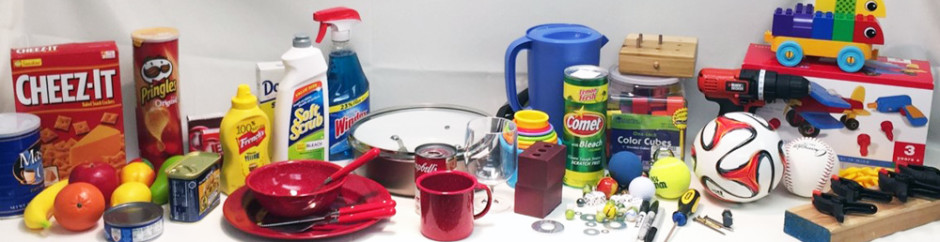
The YCB Object Set is a collection of carefully described items for robotic testing. It was created in 2015 at Yale University (Yale-CMU-Berkeley) and quickly became an international standard. The set includes both simple geometric shapes and household items: cups, boxes, tools, packages. For each object, precise 3D models, physical parameters, mass, and even surface characteristics are documented. Thanks to such detail, the same tests can be repeated in different laboratories and yield comparable results. Detailed information is available on the official website.
What Types of Failures Can Be Implemented Using YCB
In manipulation tasks, a robot may encounter a whole spectrum of failures. Classic scenarios include:
- loss of grip due to inaccurate orientation of the gripper
- slipping of the object when friction is incorrectly estimated
- loss of balance during movement
- actuator overload when attempting to lift an object that is too heavy
- accidental collisions or incorrect response to obstacles.
YCB allows each of these situations to be modeled with high precision. Researchers can change the orientation, position, or dynamics of objects to test the robustness of algorithms. In laboratory and virtual experiments, the YCB set is used to create standard tasks: monitoring the transfer of boxes, sorting items, working in confined spaces, or with special surfaces. This approach saves time and resources, as well as ensures the objectivity of tests.
The Concept of the "Failure Point": An Engineering Perspective on System Limits
The term "failure point" comes from engineering and denotes the critical value of a load or parameter after which the system ceases to function properly. In everyday life, this can be compared to the moment when an overloaded chair suddenly breaks under the weight. Car developers use crash tests—they crash the car into an obstacle and record the moment when the body can no longer withstand the load.
In the world of video games, for example, in JetX, a similar "point" is demonstrated as an instant break in trajectory when the threshold of mechanical strength is exceeded. This game was chosen as an example for a reason, as it perfectly illustrates this concept. We personally tested this theory on the site indianjetx.com, where online casinos for playing JetX are presented, allowing you to play free demo versions.
For robots, such critical states manifest themselves at the maximum tilt of an object, the maximum torque for joints, or a sharp shift in the center of gravity. The use of YCB facilitates the precise recording of these boundaries in experiments and helps to understand where the real limits of the system's capabilities begin.
YCB as a Tool for Formalization and Analysis of Failures in Robots
The use of standardized objects gives engineers the chance to pinpoint the source of an error: whether it is related to the physics of the device or to control shortcomings. This approach makes it possible to conduct reproducible and easily comparable tests in several laboratories at once. By changing the parameters of the environment and the objects themselves, researchers identify the real boundaries of algorithm robustness. For example, one can change the tilt angle of an object, the speed of movement, or the points of contact to observe in which cases a failure occurs.
Modern machine learning methods, such as reinforcement learning, are successfully used to analyze the risk of transitioning to a failure. Algorithms analyze the stable properties of YCB objects and learn to predict moments when the system approaches a failure state. Thanks to the high accuracy of the models, the results of tests obtained in simulators are very likely to transfer to real experiments. In a number of studies, including the publication by Lee et al., 2021, it was the use of YCB that made it possible to obtain reliable and reproducible test results.
Advantages and Limitations of the Standardization Approach via YCB
Comparing YCB with alternative approaches, such as using random objects or purely virtual models, several advantages of standardized sets can be highlighted:
- high reproducibility of experiments
- the ability to compare results between different institutions
- acceleration of testing and development processes
- increased objectivity in comparative analysis of algorithms.
The limitations include the specificity of the items themselves: the set does not cover the entire range of objects that robots encounter in real life. In addition, accuracy requires careful equipment calibration, and some external conditions (humidity, contamination) are not taken into account in the laboratory. Despite this, experts emphasize that standardization significantly expands the possibilities for analysis and improving system reliability.
Practical Aspects and Future Development of Failure Testing Methods
Many research groups and companies have already integrated YCB into their daily practice. This allows them to quickly compare new solutions, identify weak points, and refine algorithms to a commercial level. The expansion of standard sets is now being discussed—new collections are appearing for specialized tasks, for example, for working with soft and flexible materials.
Publications in recent years show a steady increase in interest in the reliability of autonomous systems. The results of laboratory tests are being applied in medical assistants, warehouse robots, and service devices for home use. This contributes to the accelerated introduction of high-tech solutions to the mass market.
Standardized approaches are becoming a key factor for confident progress in creating safe and robust robots. The development of testing methods and the improvement of failure models are increasingly determining the speed at which new autonomous systems appear. The only question left is: what new standards will emerge in the coming years and how will they affect the future of robotics?


 Saving...